449 lots. 4,000 sq ft each. Right next door.
This isn't speculation: it's from the developer's own application. Sunbirds RV Resort & Village is described as a seasonal RV and tiny-home community with a clubhouse, pools, playgrounds, sports courts, fitness facilities, and laundry.
What the Developer Submitted
The All In Allen Comprehensive Plan supports the county's rural agricultural character: a category where "significant growth is not anticipated" and homes "typically rely on wells and septic systems" (p. 83). This property is zoned Rural Agricultural. The proposed 449-lot commercial RV park is inconsistent with the county's own land use framework.
More than five years of IDEM violations at developer's existing RV park
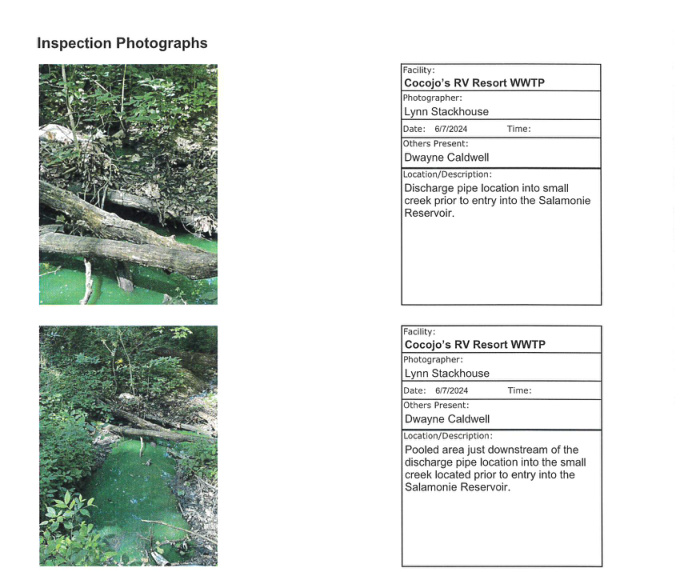
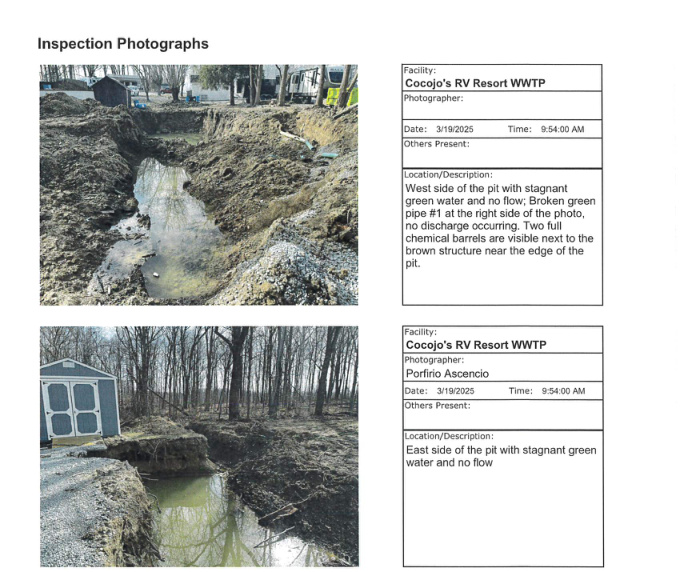
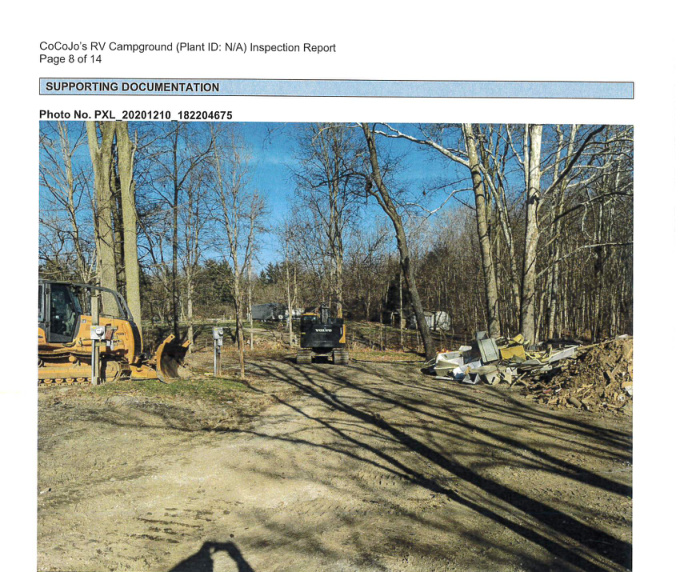
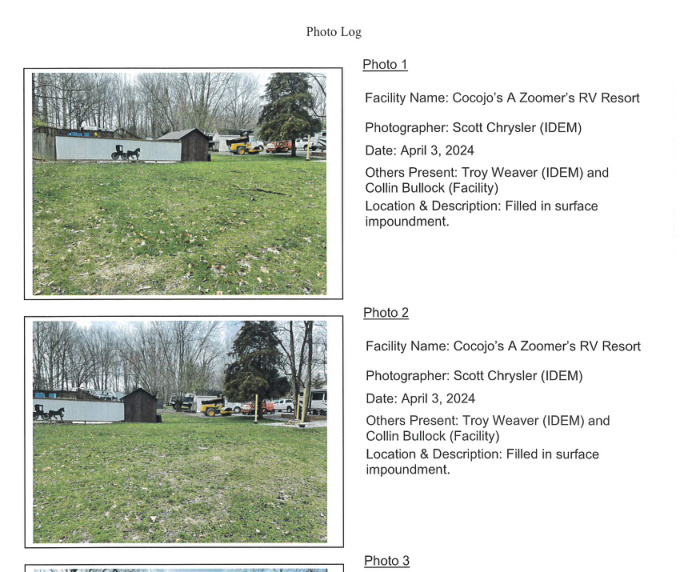
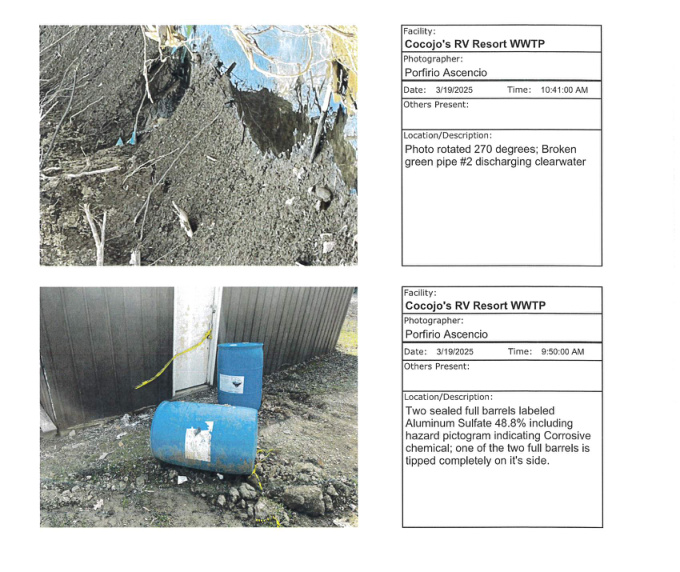
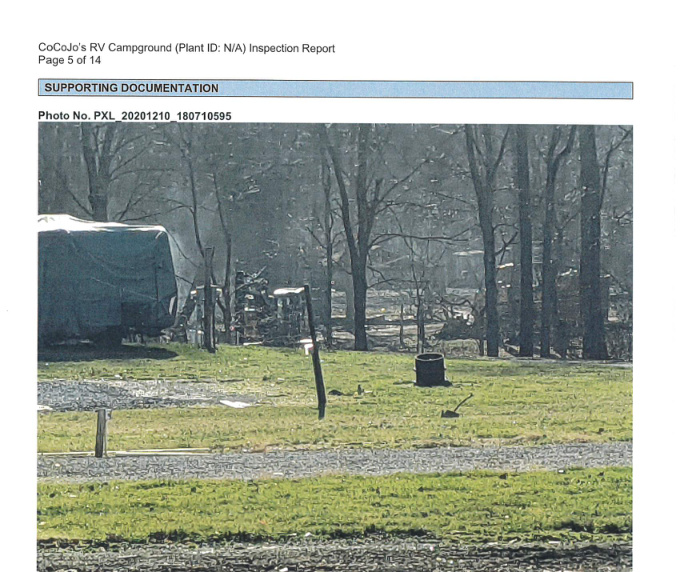
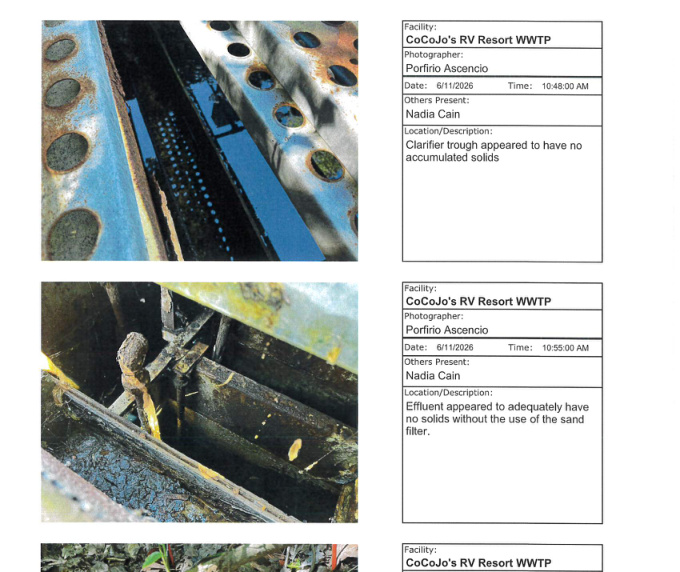
Indiana Department of Environmental Management enforcement records from 2020–2026 document enforcement actions and compliance problems at the developer's existing CoCoJo's RV Resort in Lagro, Wabash County. The timeline below summarizes the public record; the complete 176-page file is available for review. These records are presented so the Board can consider the developer's operating history when evaluating the proposed Sunbirds RV Resort & Village.
Illegal Open Burning & Asbestos
IDEM cited the facility for open burning of demolished mobile home frames, prohibited for businesses under Indiana law. The operator also failed to conduct licensed asbestos inspections before demolition and failed to notify the state, as required. Resulted in an Agreed Order and civil penalty. IDEM photographic evidence shows heavy equipment at the burn pile site. [PDF pp.1–14, 27–36]
Chronic Wastewater Failures
IDEM's Jan 2021 Noncompliance Letter documented self-monitoring failures and effluent limit violations. By July 2023, the air lift return was still nonfunctional, lab practices remained deficient (no QA/QC, missing bench sheets), and effluent exceedances continued across TSS, Ammonia Nitrogen, Phosphorus, and CBOD through early 2023: a pattern of operational noncompliance years before the major enforcement cases. [PDF pp.19–26, 42–47]
Illegal Creek Discharge & Sewer Ban
IDEM Emergency Response conducted dye testing proving the WWTP was discharging effluent into an unpermitted local creek (Incident #112732). The facility operated at 135% of design capacity in 2023 and exceeded limits for TSS, Ammonia-Nitrogen, E. coli, and phosphorus. IDEM issued a formal Sewer Ban Early Warning and documented inoperable sand filters, exposed sewer connections, and missing safety guards. The resulting Agreed Order requires 12 months of continuous compliance. [PDF pp.66–102, 105–165]
Open Dumping into Surface Impoundment
IDEM Office of Land Quality cited the facility for open dumping of solid waste (burnt trailers, wood scraps, and debris) into an unapproved, backfilled wastewater polishing lagoon. The owner was required to submit a formal Surface Impoundment Closure Plan for proper excavation and disposal of solid waste and residual WWTP sludge. [PDF pp.50–65]
Ongoing Violations Despite Enforcement
June 2025: Phosphorus discharge violation at Outfall 001 due to insufficient chemical dosing. June 2026: IDEM's most recent inspection found Maintenance rated Unsatisfactory (sand filter motor inoperable, dechlorination tank uncleaned, corrosion throughout), with Operation, Lab, and Effluent Compliance all rated Marginal. The facility remains under an active Agreed Order, yet violations continue. [PDF pp.166–176]
The paper trail
Read the actual application and supporting materials.
Eight reasons this doesn't belong here
Land Use Incompatibility & Agricultural Preservation
A commercial RV park is fundamentally inconsistent with the agricultural character of our community. The county's own All In Allen Comprehensive Plan protects the county's rural agricultural character: a designation where "significant growth is not anticipated." This property consists of fertile, valid farm ground zoned Rural Agricultural, and paving it over for 449 transient commercial sites directly violates the county's adopted land use framework.
Groundwater & Stormwater Runoff
The All In Allen Comprehensive Plan notes that properties in this rural agricultural designation "typically rely on wells and septic systems," not commercial-scale utility demands. No hydrogeological study has been completed to prove our aquifers can support 449 high-density sites drawing from commercial wells. Furthermore, the massive increase in impermeable surfaces from paved roads and 449 camper pads will create severe stormwater runoff issues, threatening to overwhelm local drainage and carry pollutants into our environment.
Traffic & Public Safety
Yoder Road and surrounding rural routes were deliberately maintained for low-density use in accordance with the All In Allen vision. They weren't built for a constant influx of massive RVs, trailers, and commercial traffic. School buses, farm equipment, and emergency vehicles already share these narrow routes, and adding high-volume transient traffic creates a severe public safety hazard.
Environmental & Wildlife
Habitat disruption, noise, and light pollution will degrade the natural environment that defines our quality of life. High-density commercial developments belong in designated commercial corridors, not woven into sensitive rural ecosystems.
Loss of Rural Character
The All In Allen plan was designed specifically to protect the landscape we are fighting for. People born in this area chose to stay, and people from outside chose to move here, because of the open fields, agricultural buffers, and unobstructed sunsets that define this community. Those are irreplaceable. Once paved for commercial use, they are gone forever.
Quality of Life
Noise, 24-hour lighting, transient occupancy, and commercial activity are incompatible with the peace residents expect here. The constant turnover of 449 transient lots fundamentally alters the stable, neighbor-focused way of life that established residents have spent decades building.
Property Values
Whether born here or new to the area, families invested in their properties based on the rural character guaranteed by the county's zoning plans. People chose this community, and are raising families here, because of what the All In Allen plan promised to protect. A high-turnover, transient commercial facility next door circumvents those protections and will diminish the property values and desirability everyone relied on.
Density Incompatible with Rural Agricultural Designation
The All In Allen Comprehensive Plan defines the rural agricultural character of the county as "low intensity residential areas within the broader agricultural landscape" with "clusters of single family homes on larger lots" where "significant growth is not anticipated." A 449-lot commercial RV park on agricultural land is the opposite: high-density, high-intensity, and transient. The plan's own data shows existing development in these areas averages ~1.88 units per acre. A 449-lot commercial park on farmland is entirely out of scale with the designated land use.
"Unchecked growth, or sprawl, stresses existing infrastructure, requires expensive service extensions, increases maintenance costs, encroaches on valuable agricultural areas, and disturbs the rural character that helps define the County."— All In Allen Comprehensive Plan (Effective March 13, 2023), p. 40
Facts you can use
Evidence-based arguments for letters, public comments, and BZA testimony. Each point cites the source document.
The proposal conflicts with the county's own land use plan
- All In Allen Comprehensive Plan protects the county's Rural Agricultural character
- It is classified as an area where "significant growth is not anticipated" (p.83)
- The plan warns that sprawl "stresses existing infrastructure, encroaches on valuable agricultural areas, and disturbs the rural character" (p.40)
- 449 commercial lots on agricultural land directly contradicts the county's adopted planning framework
- Rural Agricultural properties "typically rely on wells and septic systems"
- No commercial-scale utility infrastructure exists to support 449 lots
No groundwater or septic study was submitted
- The application includes no hydrogeological study proving the aquifer can support 449 commercial well draws
- No septic capacity analysis was provided for surrounding properties that depend on well water
- The developer's existing facility ran at 135% of design capacity in 2023 and received a formal Sewer Ban Early Warning (IDEM Case 2024-30387-W, PDF pp.66–102)
Review the public environmental record
- IDEM records involving CoCoJo's RV Resort are summarized in the Environmental Record section above
- The full 176-page IDEM enforcement record is available for review and download
- Use the documented case numbers and page references when writing or speaking to the BZA
Roads and traffic are incompatible with the proposal
- Yoder Road, Zubrick Road, and surrounding routes were designed and maintained for low-density rural agricultural use
- 449 RV lots would generate continuous heavy-vehicle traffic
- School buses, farm equipment, and emergency vehicles already share these narrow roads
- No traffic impact study was submitted with the application
- All In Allen plan explicitly notes rural roads are not intended for high-volume commercial traffic
The planned buffer is inadequate
- Perimeter buffer: 25 feet total, with only 10 feet of landscaping
- Individual RV lots sit 4 feet from the lot edge
- Adjacent residential properties would have no meaningful separation from 449 commercial campsites
The density is incompatible with Rural Agricultural designation
- All In Allen defines the county's rural agricultural character as "low intensity residential areas" with "clusters of single family homes on larger lots" (plan p.77)
- 449 commercial RV lots are the opposite of this designation
- Existing development in these areas averages ~1.88 units per acre (plan p.42)
- A 449-lot commercial park is orders of magnitude above that scale
- The plan states "significant growth is not anticipated" in rural agricultural areas
- A commercial RV park is not listed among the permitted primary or secondary uses for Rural Agricultural land
Approval would set a dangerous precedent
- Granting a use variance on agricultural land zoned Rural Agricultural weakens the All In Allen plan for every future application in the county
- Established residents purchased property relying on existing zoning protections
- A variance retroactively devalues that reliance
- If this 449-lot project passes, there is no principled basis to deny the next one
We're organized. We have counsel. We're ready.
Michael Hoffman of Beers|Mallers has joined our efforts to represent us in opposing this RV park. He and his family are area residents. This is personal for him, too. Legal representation means our letters, our evidence, and our presence carry organized weight before the BZA.
Subcommittees — We Need Your Expertise
Farmers — We Need Your Voice
Agricultural impact is one of the strongest arguments against commercial rezoning. If you own or farm land in the area, your written support speaking to soil quality, crop yields, and the importance of preserving farmland carries unique weight with the BZA. Please write in.
Write Your Letter of Opposition
- Your name & property address
- State your opposition: "I oppose the Sunbirds Use Variance for its RV Park proposal (UVAR-2026-0029)"
- Describe the impact on you, your property, and our community
Send to: ACFWBZAZHO@allencounty.in.gov
This is personal.
Hear from the people who call this place home.
Help protect our rural community.
Every signature, every letter, and every voice matters.
Support the Cause
Legal representation, expert consultations, and outreach materials cost money. Every donation keeps our case strong.
Donate on GoFundMeKeep up with the fight between meetings.
Join the Facebook GroupWho to reach
Board of Zoning Appeals
Decides the Sunbirds use variance. Your letters and hearing testimony go here.
Case: UVAR-2026-0029
Members:
• Adam Day (Commrs, term ends 12/31/29)
• Ron Kohart (Commrs, term ends 12/31/29)
• David Bailey (Plan Comm, term ends 12/31/26)
• Dan Gabbard (Council, term ends 12/31/28)
• Jerry Ehle (Commrs, term ends 12/31/28)
• Robert Eherenman, Legal Counsel
Planning Services
County staff who review the application and advise the BZA. Direct questions and records requests here.
Executive Director
Jacob Rose
Senior Land Use Planner
Email the Department: dps@allencounty.us
Phone: 260-449-7607
Web: Planning Services →
Allen County Commissioners
The county's elected governing board. They appoint most BZA members and shape land-use policy.
District 1 Commissioner
Therese Brown
2nd District Commissioner
Richard Beck
3rd District Commissioner
Email the Board: boardofcommissioners@allencounty.in.gov